
In the last week of September, the ranking alerts on my client accounts started firing one after another. Each alert flags a cumulative position movement of more than 100, and I was seeing drops of 500, 1,200 and 2,000 across almost every client I manage. Our ranking dashboard showed the same steep decline across the whole business.
At first, we put it down to Google’s September spam update, which started rolling out the same week. A drop that size, across that many unrelated businesses, didn’t fit. Rank trackers run automated Google searches for each keyword and record where a site appears in the results. Our checks pointed instead to a problem with that collection, in our tool and others: keywords showed as falling sharply or vanishing altogether while the same pages kept ranking and kept earning clicks. Those false drops are now sitting in September’s month-end reports.
The Change
Ahrefs greeted users with an in-app banner about “changes in how Google serves search results, which may cause inconsistencies in some SERP data.” AgencyAnalytics, a reporting platform for agencies, went further and named the cause: “Google changed how it responds to automated ranking checks, and some checks now come back incomplete.” AgencyAnalytics is now excluding its affected checks from 24 September to 2 October.
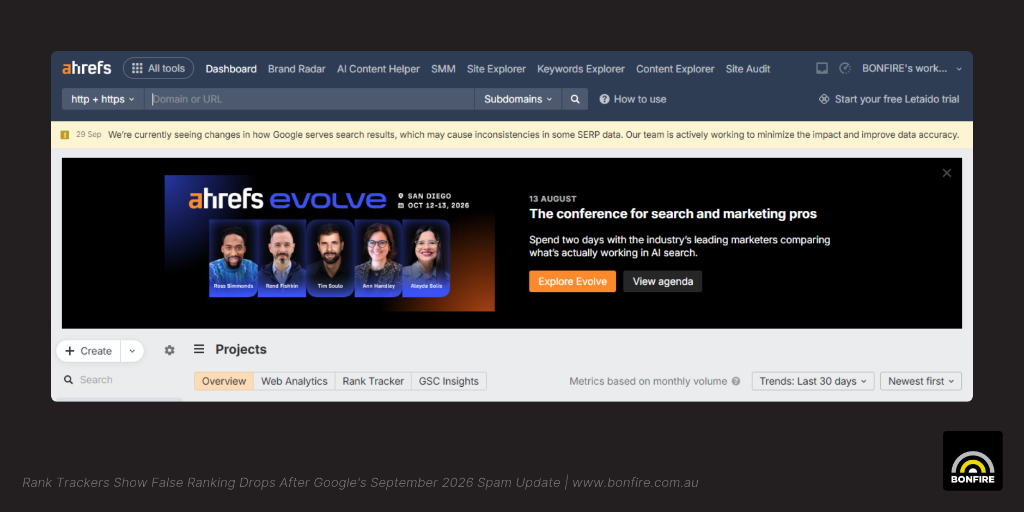
Ahrefs in-app notice, 29 September 2026.
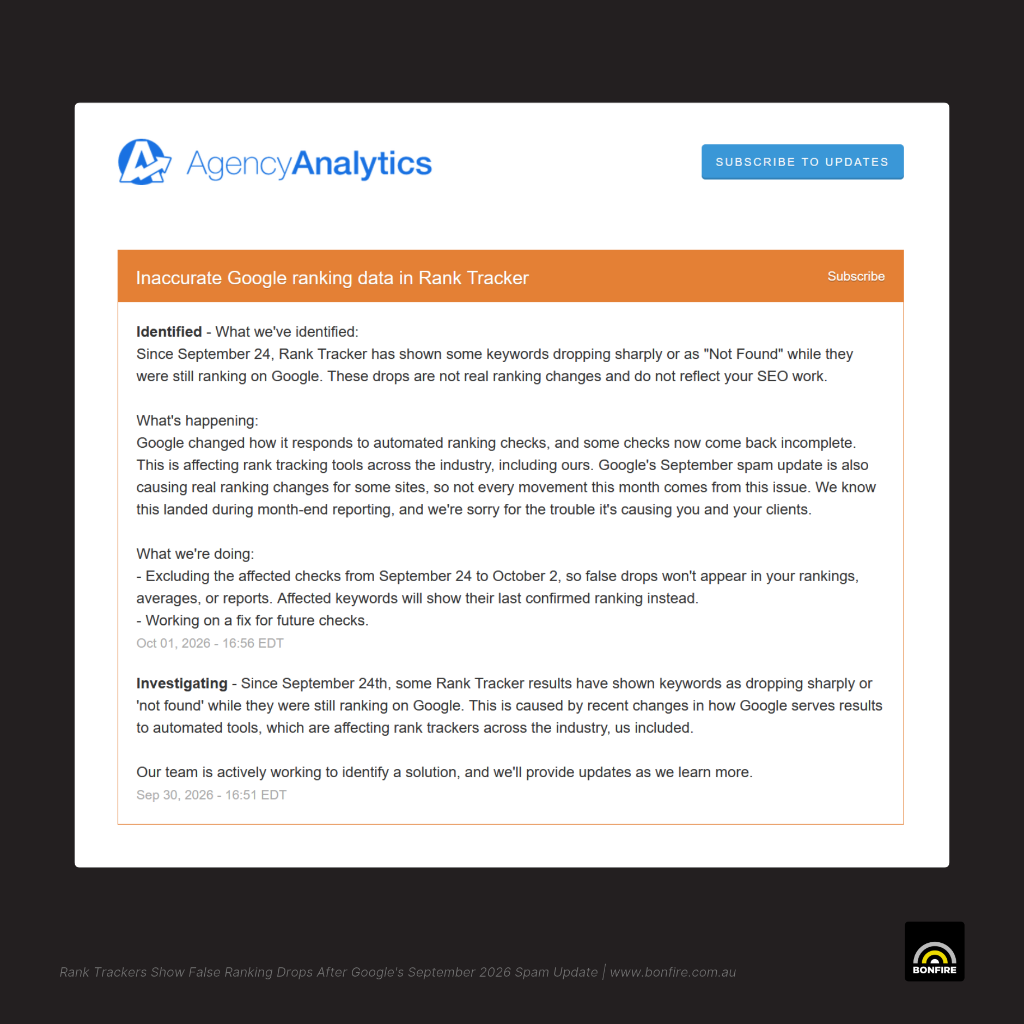
AgencyAnalytics status update, 30 September and 1 October 2026.
Google’s September 2026 spam update started on 24 September. Google said the rollout would take up to two weeks, a second wave hit on 30 September, and Google hasn’t yet confirmed it has finished. Because the rollout is still moving some rankings for real, not every drop in this month’s reports is a tracking error.
Our ranking dashboard tracks cumulative position movement across every client account. The line barely moved during the August spam update. In the days after the September update began, it fell by roughly 30,000 positions.
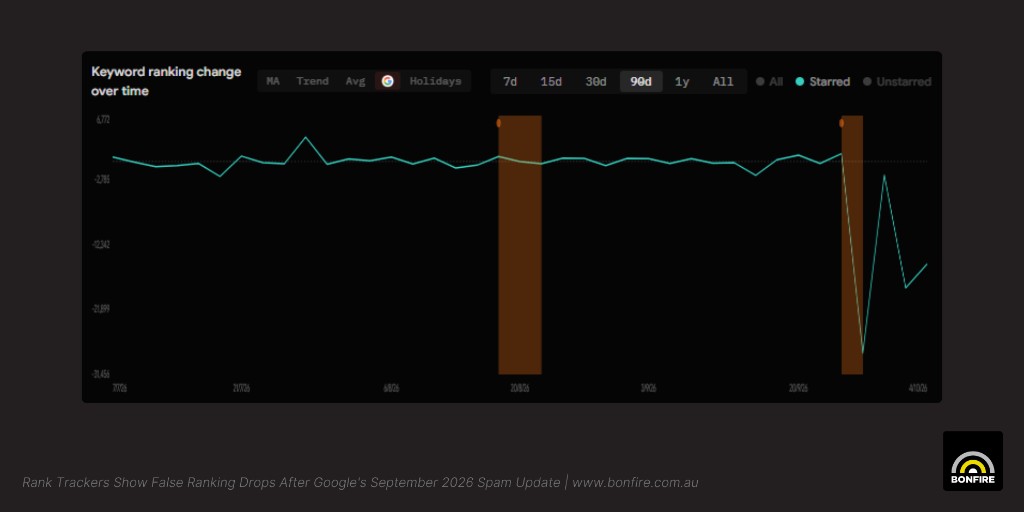
Cumulative keyword ranking change across client accounts, 90 days.
What Google Is Actually Trying to Do
Google is making its results harder for tools to collect. In January 2025, Google began requiring JavaScript to load search results. In September 2025, Google stopped supporting the num=100 parameter, which let tools pull the top 100 results in a single request. In August 2026, Google started routing result links through google.com/goto redirects, which a Google spokesperson described as part of “a long history of deploying technical measures against evolving forms of abuse.”
Each step raises the cost of collecting Google’s results, and every rank tracker depends on collecting them. Google builds its results for people searching, and every change like this makes the tools that report on those results less reliable.
How to Tell a Real Ranking Drop From a Tracking Error
I took keywords our ranking dashboard said had dropped out entirely and ran each one through four checks.
- The raw data. Our dashboard pulls results from a third-party provider. Its raw output for those keywords showed low-value results, heavy on marketplaces and forums, and our clients nowhere to be found. In the previous check, the same clients ranked first, or at least on page one.
- The check URL. Every result in that output comes with a link to the search it recorded. Opening those links showed a normal results page, with our clients where they had always been.
- Live search. An incognito search returned the results we saw before the disruption.
- Search Console. Search Console reports Google’s own data from real searches, and the clicks it recorded to our clients’ sites held steady through the same weeks our dashboard showed them falling. Real people were still finding our clients and clicking through.
Real people were still finding our clients and clicking through.
Our dashboard swung harder than tools like Ahrefs or Semrush because we check rankings up to three times a week. Larger tools collect results at far greater volume, so they can smooth out a bad day of data. Three snapshots a week doesn’t afford us that same luxury.
The Performance Impact
Reporting
Ranking data from 24 September is unreliable until Google confirms the spam update has finished.
Lead quality
At the clients we checked, clicks held through the whole period, and for some the latest week was among the strongest since July. People kept clicking through at their usual rate.
Rankings have become a guiding light, showing where a business is visible and where the gaps sit. Clicks, enquiries and sales tell you whether following that light paid off.
What We’re Telling Our Clients to Do
Here’s what we’re checking with every client before acting on September’s reports:
- Set aside ranking data from 24 September. Keep it out of client-facing conclusions until Google confirms the rollout is complete, then compare against August.
- Check Search Console clicks by page and query. Clicks show whether real people are still reaching your site.
- Check enquiries and sales in GA4. Forms, calls and purchases from organic search over the same window show whether the business has felt anything.
- Raise it if clicks and enquiries both fall. A sudden drop in both from late September is worth a conversation with your agency. A falling ranking line on its own isn’t.
Decoding the Algorithm is a Bonfire series on the platform changes that matter for Australian marketers. Browse every post in the series.