
In April, a WA business owner sent through their monthly report and asked a fair question: why were conversions down fifteen percent when nothing about the business had changed? Nothing had changed. Google had.
In April 2026, Google restructured the way GA4 assigns credit for conversions, and the numbers moved because the model moved, not because a single customer behaved differently. The business owner I was speaking to was about to cut budget from a channel that had performed exactly as well as the month before.
That is the problem in one report. Most businesses are not measuring their performance. They are reading what the platform decided to show them.
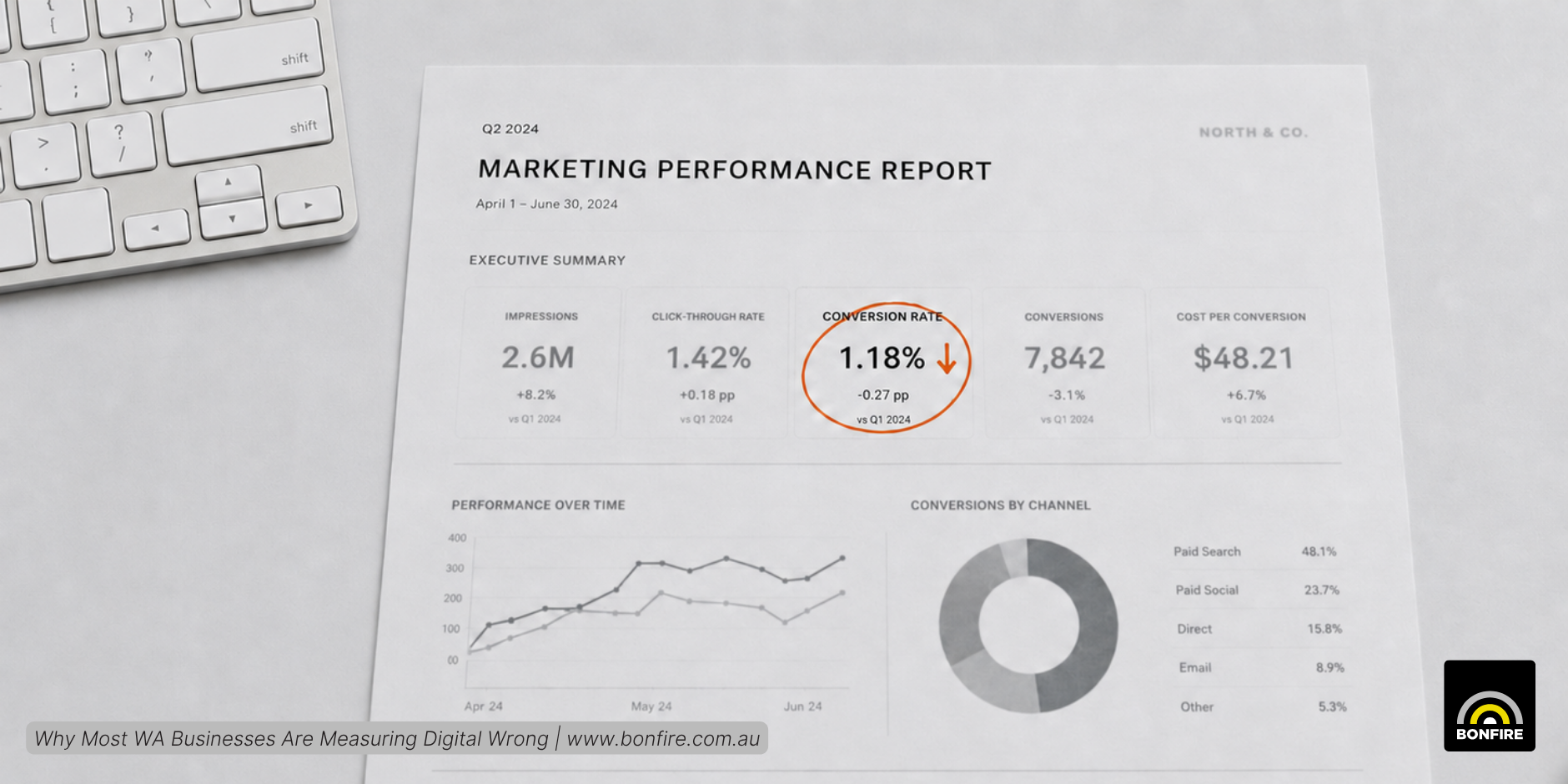
One number moved. The business behind it performed exactly as well as the month before.
We live in a multi-channel world. People rarely see one ad, visit one website, and buy straight away. They may first discover your brand through Meta, search for you later on Google, read reviews, visit your website, compare options, and then finally make an enquiry or purchase.
The problem is that many businesses give all the credit to the final click, even though several other channels may have helped build trust along the way. If we only measure the last action, we can make the wrong decision. We might cut budget from the very channel that first introduced the customer to the business, simply because it did not get the final conversion.
That is why understanding the full customer journey matters. Good measurement should show which channels are creating awareness, which are building trust, and which are helping close the sale.
In WA the distance between what the report says and what the business actually knows is wider than most owners realise. Marketing here often sits with one person, or with the owner directly. The monthly numbers come from an agency that has held the relationship for years, and they are trusted because the relationship is trusted. The instinct to interrogate them, common in markets with more agency churn, is less embedded here. For most of the past decade strong conditions covered the difference, because the business grew whether or not the measurement was sound. Tighter conditions remove that cover.
Activity is not performance
Most businesses are not really measuring business performance. They are measuring activity. Clicks, sessions, impressions and conversions can all be useful, but they do not always show whether the business made money. A conversion in GA4 might be a form submission, a phone click or a quote request. That is a signal, but it is not the same as a confirmed sale, a new customer or profit.
This is why the April 2026 GA4 change matters. If Google changes the way conversions are counted or credited, the numbers in a report can move up or down even if customer behaviour has not changed. That is exactly what happened. Google recalibrated its data-driven attribution, removed first-click attribution entirely, and migrated accounts across without telling most of the businesses affected. Smaller accounts, which describes most WA businesses, fell back to last-click automatically because they sit below the conversion volume the new model needs.
The report changed. The business did not.
Underneath the platform problem is a simpler one. Every platform measures results a little differently, so businesses cannot rely on Google or Meta alone to tell them if their marketing is working. They need to understand their own basic numbers, like how many visitors become enquiries, how many enquiries become sales, and what each sale is worth. Once those numbers are clear, the business can work out how much it can afford to pay to win a new customer. That is what Cost Per Acquisition really means. Without them, it is guessing. Most of those numbers live inside the business, not the agency: only the business knows how many enquiries became sales and what each sale was worth. The agency's job is to connect its platform data to them. If that connection is not happening, the client should be asking why.
Good measurement starts with the business outcome first. What are we trying to achieve? More sales, better leads, higher profit or stronger repeat business? From there, the business can work backwards and decide what needs to be tracked across the website, CRM, phone calls, forms, sales team and ad platforms. The real question is not just, "Did this ad get a conversion?" It is, "Would this customer have bought from us anyway?" Most WA businesses have never asked that question, because their measurement was never built to answer it. It was built around what the platform makes easy to count.
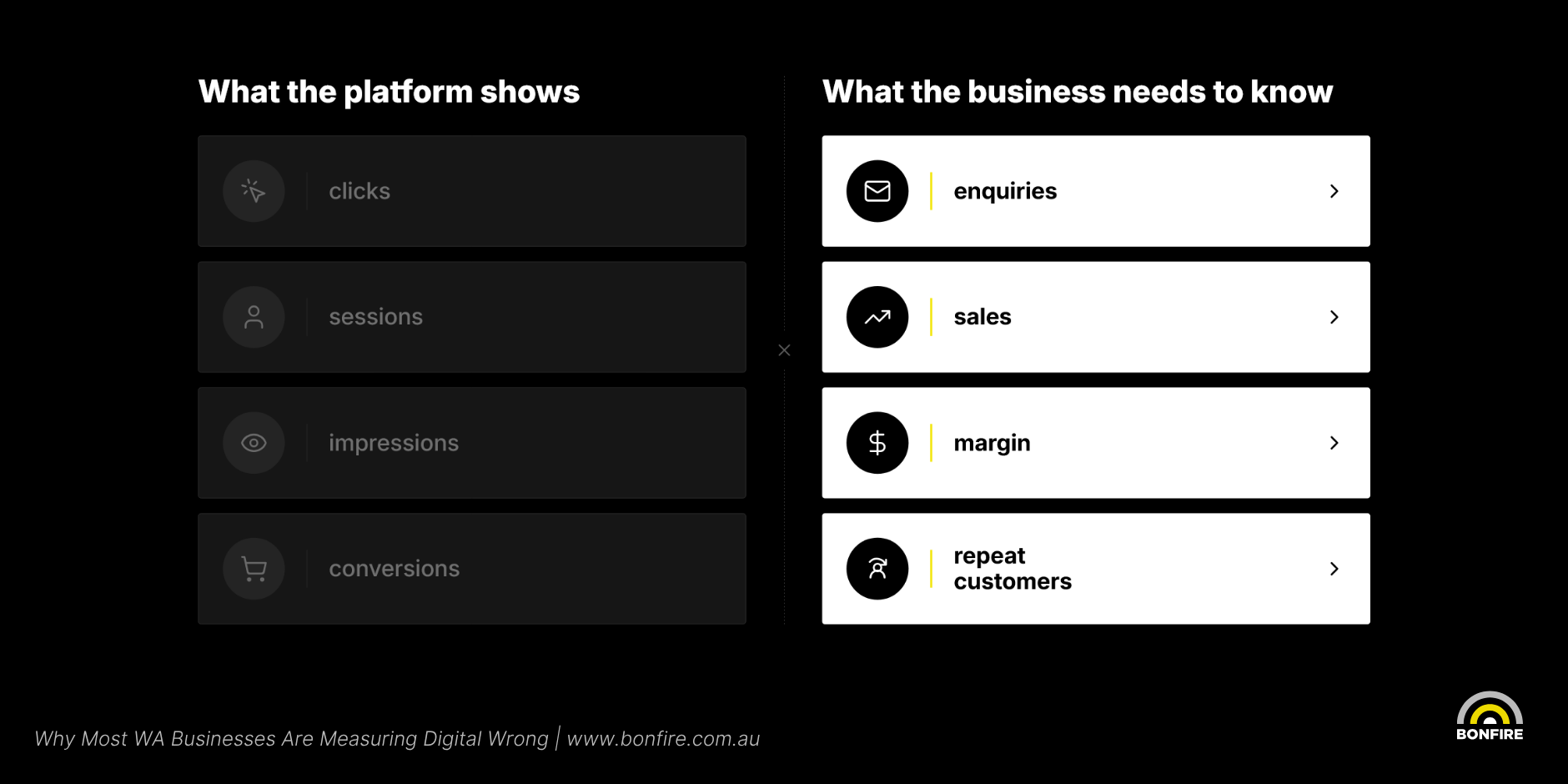
Activity is what the platform counts. Performance is what the business keeps.
What you measure is what you become
Businesses cannot keep hammering the bottom of the funnel and ignore everything that happens before the sale.
Bottom-of-funnel activity matters. Businesses need leads, enquiries and revenue. But if that is the only focus, everyone starts saying the same thing, chasing the same customer, with the same offer, at the same point in the journey. Over time, this becomes a race to the bottom. It commoditises prices, drives ever-shorter offers, and breeds a "deal-of-the-month" mindset where the only thing setting a business apart is its newest and lowest price yet. It might win quick sales, but it erodes both the product and the brand. Measurement and strategy have to work together: a business needs to understand its numbers and know where it is trying to go. Without both, the easiest option is always to chase the next quick sale.
